
0769-23388351
Toggle Navigation

In the practical application of neodymium-iron-boron magnets, there is a common misconception regarding the “maximum operating temperature.” It is widely believed that as long as the temperature remains below this threshold, the magnet will not demagnetize. For example, the 38SH grade has a nominal maximum operating temperature of 150°C, which is often simplistically interpreted to mean that using it at 120°C or 130°C is completely safe. In fact, this understanding is inaccurate.
From the perspective of demagnetization, neodymium-iron-boron magnets undergo two distinct changes during heating: first, reversible demagnetization, where magnetic properties temporarily decline at high temperatures but fully recover once the temperature returns to normal; and second, irreversible demagnetization, where the internal magnetic domain structure changes, leading to permanent loss of performance. Generally, within the low-to-medium temperature range, the behavior is primarily reversible demagnetization. However, as temperatures rise further, or if the magnetic circuit design is improper, irreversible demagnetization may be triggered—this is the risk that must be avoided in engineering design.
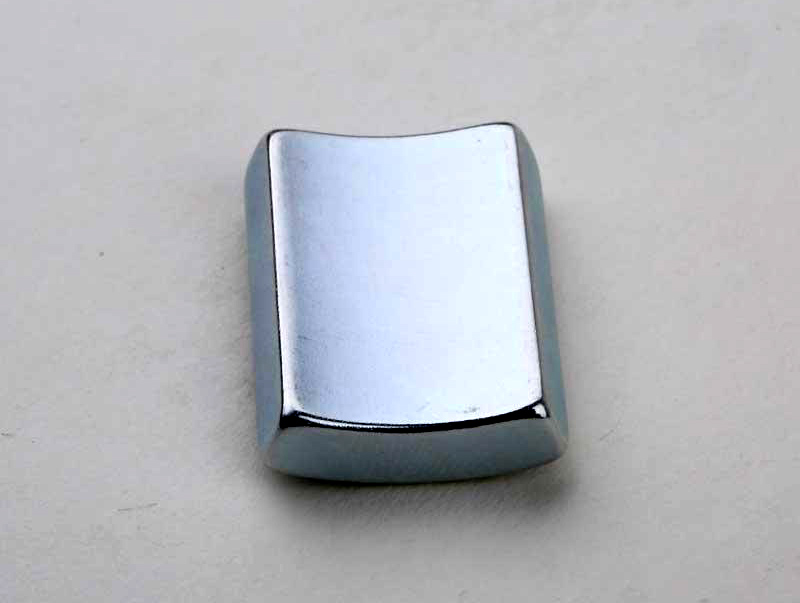
Surface galvanized arc segment neodymium rare earth magnet
The so-called “maximum operating temperature” is not, in essence, the “temperature at which demagnetization begins,” but rather an engineering-defined parameter. Taking the 38SH as an example, the 150°C specification means that under standard test conditions (such as standard dimensions, open magnetic circuit, and constant temperature for a certain period), the magnet’s irreversible demagnetization loss is controlled within 5%. Therefore, even if the temperature does not reach 150°C, magnetic performance will still decline; however, in most cases, this decline is reversible and can be restored after cooling.
In practical applications, selecting a magnet based solely on the maximum operating temperature often creates potential risks. This is because whether a magnet undergoes irreversible demagnetization depends not only on temperature but is also closely related to factors such as the operating point (load line), magnetic circuit structure, air gap size, and external demagnetizing fields. For example, in open-circuit or weak magnetic field environments, even if the temperature does not reach the rated upper limit, the magnet may enter the inflection point region of the demagnetization curve prematurely, resulting in permanent loss.
Therefore, from an engineering design perspective, the prudent approach is to allow sufficient temperature margin rather than operating “right at the upper limit.” It is generally recommended to maintain a safety margin of 20°C or more above the maximum operating temperature, and to conduct a comprehensive assessment in conjunction with the specific application environment (such as internal temperature rise in motors and local hotspots).
Other introductions about magnet temperature;
List of high temperature resistant permanent magnets
Temperature resistance and surface treatment of brushless DC motor magnets
Customers from the United States, the United Kingdom, Australia, Japan, Poland and other customers are looking for ferrite cylindrical magnets. Welcome to contact the Courage magnet manufacturer. Our company is located in Dongguan, China. There are many ready-made sizes and low prices. Like the main picture...
The sample is a small-sized Y35 ferrite magnetic block with a specification of 3 × 1.3 × 4mm, magnetized along the length direction, and a surface magnetic field of about 1300 Gauss....
This is a very small rectangular ferrite block magnet, measuring 2.45 mm in length and 1 mm in both width and height. It is magnetised along its length and is barely noticeable when held in the hand....
7.4x6x5mm Ferrite Small Block Magnet Introduction,Material: Hard Ferrite (Ceramic),Shape: Block / Rectangle / Bar,Coating: No Coating,Grade (Chinese Stardard): Y30,Operating temperature: -40°C to 250°C,Delivery time: 7-15 days,Magnetization direction: thickness....
U-shaped neodymium magnets are a type of high-performance permanent magnet material with a structure resembling the letter ‘U’. Manufactured from sintered neodymium-iron-boron, they are characterised by high magnetic energy product....
This is a radial 4-pole ring (Hollow cylinder) magnet, the material is bonded NdFeB, with high magnetic performance, the size is 16mm outer diameter, inner hole 5mm, height 20mm, surface gray epoxy treatment, suitable for water pump motor...
This product is a 4-pole ring magnet, injection-molded ferrite material, the sample size is 22mm outer diameter, 7mm inner diameter, 4mm thickness, 2 N poles and 2 S poles, mainly used for push rod motors, magnetic induction devices, encoders, etc.,...
This is a radial 2 pole circular magnet designed specifically for magnetic encoder chips. It is made of sintered neodymium-iron-boron with N35 grade performance and is suitable for standard environments....