
0769-23388351
Toggle Navigation

How are ceramic ferrite magnets made? What are the processes? Today, the odd magnet manufacturer will introduce to you in detail to satisfy your curiosity.
The picture below is the flow chart of the production process of ferrite magnets
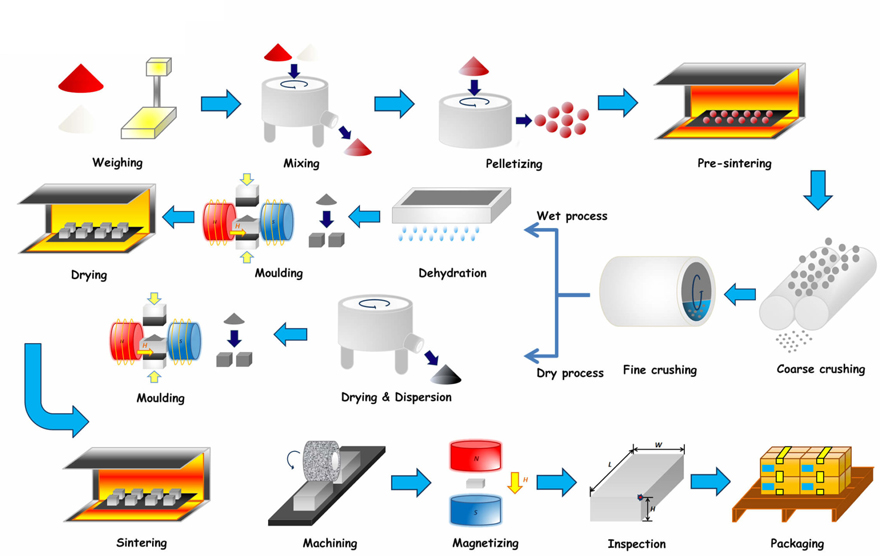
The following is the process introduction;
Weighing and Mixing
Ferrite raw materials include main raw materials, additives and fluxes Fe2O3, BaCO3, SrCO3 and CaCO3 are the main raw materials of ferrite. The weighing process needs to strictly follow the formula, otherwise the ideal magnetic properties cannot be obtained. After the raw materials are weighed, they are mixed in special equipment. Ingredient uniformity is based on the mixing process. There are many factors that affect the uniformity of a mixture's components.
Granulation
In order to ensure the smooth progress of the solid phase reaction process, the mixture needs to be granulated before pre-sintering. During the granulation process, the solution will be sprayed into the mixture. The particle size of the pellet material has an effect on the burn-in time.
Pre-sintered
The purpose of pre-sintering is to fully ensure the solid-phase reaction of the raw materials. After pre-sintering, most of the raw materials will be converted into ferrite phase. The pre-sintering process will also improve deformation, shrinkage and density. The pre-sintered powder can be used as a raw material for sintered magnets, bonded magnets and wave absorbing materials. Now most ferrite manufacturers directly purchase the pre-sintered powder.
Ball milling
In this step, the pre-sintered material will be pulverized into a fine powder. The crushing process will be completed by the ball mill equipment. The grinding medium is steel balls and water.
Forming
On the basis of traditional classification methods, ferrite magnets are divided into two categories: isotropic and anisotropic. Ferrite molding methods are also divided into two types: wet method and dry method. The molding process is highly technically intensive.
Sintering
Like other types of sintered magnets, the sintering step is also very important for ferrite magnets. First, the sintering process affects the microstructure of the ferrite, which in turn affects the magnetic properties of the ferrite. Unreasonable sintering parameters can lead to cracks in the magnet. , bubbles and deformations.
Machining
Processing methods of ferrite magnets include grinding, polishing, cutting and punching. It is worth mentioning that because ferrite is an insulating material, magnet manufacturers will use grinding wheels during the cutting step.
Magnetization
Use a special magnetizer to magnetize the ferrite according to customer requirements.
The above is an introduction to the production process of ferrite. The ferrite magnets produced by our company have stable performance and excellent quality. They are mainly used in various sensors, motors, speakers, electrical appliances, and handicrafts. Welcome to consult.
Ferrite related products;
Ferrite magnet article introduction;
Application and Magnetic Properties Comparison of Barium Ferrite and Strontium Ferrite
What is the hardness of ferrite magnet?
What is radial ferrite magnet? Which kinds are there?
How strong is the magnetic field of ferrite magnet? How to calculate?
This is a very small rectangular ferrite block magnet, measuring 2.45 mm in length and 1 mm in both width and height. It is magnetised along its length and is barely noticeable when held in the hand....
7.4x6x5mm Ferrite Small Block Magnet Introduction,Material: Hard Ferrite (Ceramic),Shape: Block / Rectangle / Bar,Coating: No Coating,Grade (Chinese Stardard): Y30,Operating temperature: -40°C to 250°C,Delivery time: 7-15 days,Magnetization direction: thickness....
U-shaped neodymium magnets are a type of high-performance permanent magnet material with a structure resembling the letter ‘U’. Manufactured from sintered neodymium-iron-boron, they are characterised by high magnetic energy product....
This is a radial 4-pole ring (Hollow cylinder) magnet, the material is bonded NdFeB, with high magnetic performance, the size is 16mm outer diameter, inner hole 5mm, height 20mm, surface gray epoxy treatment, suitable for water pump motor...
This product is a 4-pole ring magnet, injection-molded ferrite material, the sample size is 22mm outer diameter, 7mm inner diameter, 4mm thickness, 2 N poles and 2 S poles, mainly used for push rod motors, magnetic induction devices, encoders, etc.,...
This is a radial 2 pole circular magnet designed specifically for magnetic encoder chips. It is made of sintered neodymium-iron-boron with N35 grade performance and is suitable for standard environments....
This product is a multi pole magnetic ring with an inner diameter of 1.5mm. The material is injection molded ferrite. It adopts axial multi pole magnetization and is mainly used for DC motors. If you have a sample of similar injection molded magnetic products, please contact us for quotation....
This is a very small size rectangular block magnet with galvanized surface, 3mm length, 1.5mm width and height, with very fine tolerance, magnetized by lengthwise direction, mainly used in precision electronics, instrumentation, please contact us if you need to buy....