
0769-23388351
Toggle Navigation

Structurally, both the brushed DC geared motor and the brushless DC geared motor have a rotor and a stator. I will not introduce too much about the difference between these two types today. There are many related introductions on the Internet. Today's content mainly talks about the reducer. Why do the rotors need magnets?
To make the reducer rotate, first the control unit needs to sense the current position of the motor rotor, and then according to the stator winding to determine the order of turning on the power transistors in the inverter, so that the current flows through the motor coil in sequence to generate a forward rotating magnetic field , and interacts with the magnet of the rotor, so that the motor can be rotated clockwise/counterclockwise. The performance of the DC gear motor is related to the number of permanent magnets, the magnetic flux intensity, and the input voltage, which is also very important to the control performance. relation.
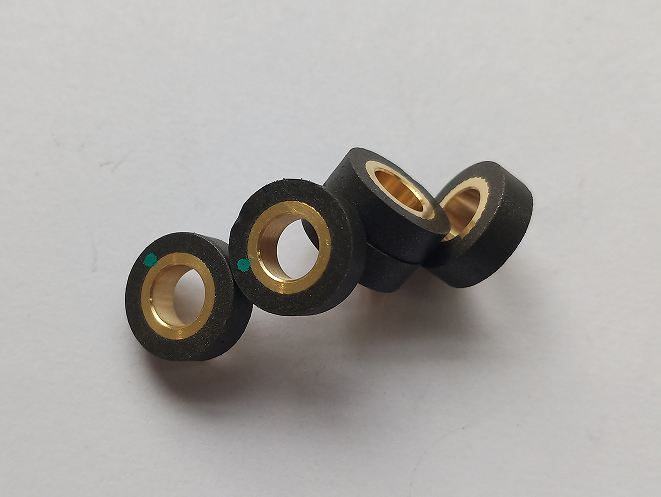
For example, the brushless DC gear motor relies on changing the alternating frequency and waveform of the current wave input to the stator coil. A magnetic field that rotates around the geometric axis of the DC gear motor is formed around the winding coil, and the magnetic field drives the permanent magnet on the rotor to rotate. The DC motor starts to rotate, and the performance of the DC gear motor is related to the number of permanent magnets and the magnetic flux intensity.
Guess your concern: what is the material of the reducer magnet?
The common types of magnets for miniature geared motors are ferrite magnets and NdFeB magnets.
The above is the introduction of why magnets are added to the reducer rotor and the magnet material. If you need to purchase motor-related magnets, you can contact our company to provide you with samples and evaluate the price.
Columns related to geared motor rotor magnets;
This is a very small rectangular ferrite block magnet, measuring 2.45 mm in length and 1 mm in both width and height. It is magnetised along its length and is barely noticeable when held in the hand....
7.4x6x5mm Ferrite Small Block Magnet Introduction,Material: Hard Ferrite (Ceramic),Shape: Block / Rectangle / Bar,Coating: No Coating,Grade (Chinese Stardard): Y30,Operating temperature: -40°C to 250°C,Delivery time: 7-15 days,Magnetization direction: thickness....
U-shaped neodymium magnets are a type of high-performance permanent magnet material with a structure resembling the letter ‘U’. Manufactured from sintered neodymium-iron-boron, they are characterised by high magnetic energy product....
This is a radial 4-pole ring (Hollow cylinder) magnet, the material is bonded NdFeB, with high magnetic performance, the size is 16mm outer diameter, inner hole 5mm, height 20mm, surface gray epoxy treatment, suitable for water pump motor...
This product is a 4-pole ring magnet, injection-molded ferrite material, the sample size is 22mm outer diameter, 7mm inner diameter, 4mm thickness, 2 N poles and 2 S poles, mainly used for push rod motors, magnetic induction devices, encoders, etc.,...
This is a radial 2 pole circular magnet designed specifically for magnetic encoder chips. It is made of sintered neodymium-iron-boron with N35 grade performance and is suitable for standard environments....
This product is a multi pole magnetic ring with an inner diameter of 1.5mm. The material is injection molded ferrite. It adopts axial multi pole magnetization and is mainly used for DC motors. If you have a sample of similar injection molded magnetic products, please contact us for quotation....
This is a very small size rectangular block magnet with galvanized surface, 3mm length, 1.5mm width and height, with very fine tolerance, magnetized by lengthwise direction, mainly used in precision electronics, instrumentation, please contact us if you need to buy....