
0769-23388351
Toggle Navigation

In modern permanent magnet motor design, the mounting method of the rotor magnets has a decisive impact on the overall performance of the motor. Among these, the embedded magnet structure is widely used in new energy vehicle drive motors, high-speed motors, and high-end industrial motors due to its excellent overall performance. Compared to traditional surface-mounted structures, the embedded magnet structure places the magnets inside the rotor core. So, what are the advantages and disadvantages of this design?
First, the embedded structure offers extremely high mechanical reliability. With the magnets enclosed within the core, they can effectively resist centrifugal forces during high-speed rotation, preventing them from flying out or falling off—making this design particularly suitable for high-speed applications exceeding 10,000 RPM. Additionally, this configuration facilitates the superposition of reluctance torque and permanent magnet torque, thereby enhancing the motor’s torque density and efficiency. Furthermore, the embedded magnetic circuit design optimizes the flux distribution in the air gap, reducing cogging torque and electromagnetic noise, resulting in smoother motor operation. Since the core provides a certain degree of protection for the permanent magnets, the motor exhibits stronger resistance to demagnetization and performs more stably under high-temperature or overload conditions.
Several Types of Rotor-Embedded Structures
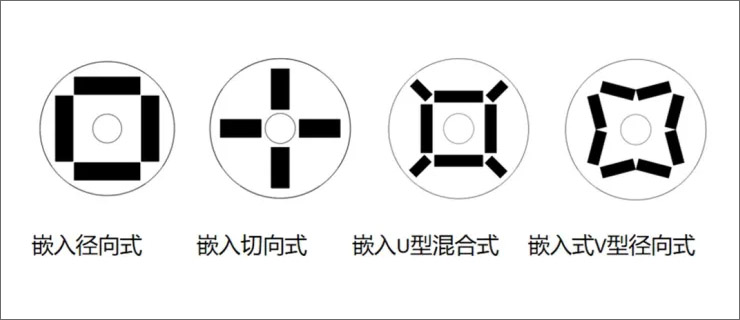
As for the disadvantages, first, the design and manufacturing complexity are relatively high. It requires the creation of precise slots for the permanent magnets within the rotor laminations, imposing strict demands on mold precision, lamination processes, and assembly consistency, thereby increasing production costs. Second, because the magnets are enclosed within the iron core, the heat dissipation path is longer, making it difficult to quickly dissipate heat. During continuous high-load operation, this may cause excessive local temperature rises, affecting magnetic performance and even posing a risk of demagnetization. Additionally, in terms of maintenance, if the magnets become damaged or fail, disassembly and replacement are difficult, and repair costs are significantly higher than those of surface-mounted structures.
The above outlines the advantages and disadvantages of the embedded configuration for motor rotor magnets. Currently, many drive motors in new energy vehicles utilize this structural design.
Edit recommend articles;
Why aren't the magnets in a water pump rotor afraid of water?
Customers from the United States, the United Kingdom, Australia, Japan, Poland and other customers are looking for ferrite cylindrical magnets. Welcome to contact the Courage magnet manufacturer. Our company is located in Dongguan, China. There are many ready-made sizes and low prices. Like the main picture...
The sample is a small-sized Y35 ferrite magnetic block with a specification of 3 × 1.3 × 4mm, magnetized along the length direction, and a surface magnetic field of about 1300 Gauss....
This is a very small rectangular ferrite block magnet, measuring 2.45 mm in length and 1 mm in both width and height. It is magnetised along its length and is barely noticeable when held in the hand....
7.4x6x5mm Ferrite Small Block Magnet Introduction,Material: Hard Ferrite (Ceramic),Shape: Block / Rectangle / Bar,Coating: No Coating,Grade (Chinese Stardard): Y30,Operating temperature: -40°C to 250°C,Delivery time: 7-15 days,Magnetization direction: thickness....
U-shaped neodymium magnets are a type of high-performance permanent magnet material with a structure resembling the letter ‘U’. Manufactured from sintered neodymium-iron-boron, they are characterised by high magnetic energy product....
This is a radial 4-pole ring (Hollow cylinder) magnet, the material is bonded NdFeB, with high magnetic performance, the size is 16mm outer diameter, inner hole 5mm, height 20mm, surface gray epoxy treatment, suitable for water pump motor...
This product is a 4-pole ring magnet, injection-molded ferrite material, the sample size is 22mm outer diameter, 7mm inner diameter, 4mm thickness, 2 N poles and 2 S poles, mainly used for push rod motors, magnetic induction devices, encoders, etc.,...
This is a radial 2 pole circular magnet designed specifically for magnetic encoder chips. It is made of sintered neodymium-iron-boron with N35 grade performance and is suitable for standard environments....