
0769-23388351
Toggle Navigation

We all know that permanent magnets are sensitive to high temperatures, especially rare earth neodymium magnets (neodymium-iron-boron). Their temperature resistance is relatively poor compared to other types of permanent magnets. Today, let's introduce the issue that everyone has been concerned about: whether neodymium-iron-boron strong magnets will demagnetize at instantaneous high temperatures.
In some cases, neodymium high-strength magnets may demagnetize when exposed to instantaneous high temperatures, but this depends on various factors, including the type of magnetic material, temperature, magnetic field strength, and exposure time. Generally speaking, high temperatures can disrupt the internal magnetic alignment of the material, leading to demagnetization.
Radial magnetized circular magnet
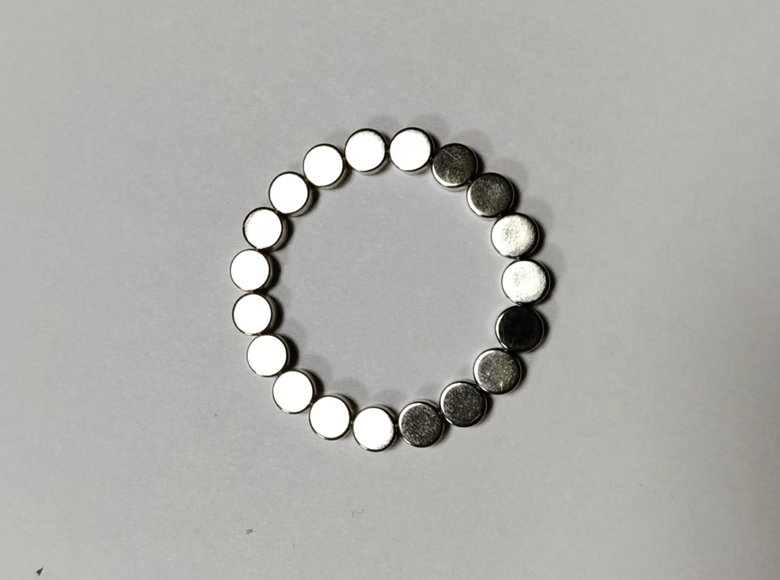
The demagnetization behavior of strong magnets mainly includes the following situations:
1. Curie temperature of magnetic materials: Magnetic materials have a critical temperature known as the Curie temperature. When the temperature exceeds this value, the material loses its magnetism. At temperatures above the Curie temperature, the magnetic moment alignment of the magnetic material becomes more random, leading to demagnetization.
2. Overheating demagnetization: If a ferromagnetic material is exposed to high temperatures for a sufficiently long period of time, the magnetic moment alignment within the material may become more disordered, resulting in demagnetization.
3. Thermal stress: High-temperature environments may lead to an increase in thermal stress in magnetic materials, which may cause changes in the material's structure, thereby affecting its magnetic properties.
It should be noted that different types of magnetic materials have varying degrees of sensitivity to temperature. Some materials lose their magnetism rapidly at high temperatures, while others may require higher temperatures to demagnetize. Therefore, whether a material will demagnetize depends on its specific properties and the temperature conditions it experiences.
In summary, exposure of strong magnetism to instantaneous high temperatures may lead to demagnetization, but whether demagnetization occurs depends on the characteristics of the magnetic material, as well as factors such as the temperature and duration of exposure.
Similar issues
Will demagnetization occur below the max working temperature of the magnet?
Can the axially magnetized magnet be demagnetized for radial magnetization?
This 1mmx1mm miniature circular magnet has a compact size and a surface magnetic field of approximately 2900 Gauss, making it suitable for precision applications with high requirements for magnet size....
This product is a miniature round magnet, made of rare earth NdFeB magnets, belonging to the ultra-small size magnet series, using N35 grade, the specific size is 1.5mm diameter, 1mm thickness, axial magnetization, surface nickel coating, tolerance ±0.05, such as If you are interested in this small magnet product, you can contact us to customize it for you....
Customers from the United States, the United Kingdom, Australia, Japan, Poland and other customers are looking for ferrite cylindrical magnets. Welcome to contact the Courage magnet manufacturer. Our company is located in Dongguan, China. There are many ready-made sizes and low prices. Like the main picture...
The sample is a small-sized Y35 ferrite magnetic block with a specification of 3 × 1.3 × 4mm, magnetized along the length direction, and a surface magnetic field of about 1300 Gauss....
This is a very small rectangular ferrite block magnet, measuring 2.45 mm in length and 1 mm in both width and height. It is magnetised along its length and is barely noticeable when held in the hand....
7.4x6x5mm Ferrite Small Block Magnet Introduction,Material: Hard Ferrite (Ceramic),Shape: Block / Rectangle / Bar,Coating: No Coating,Grade (Chinese Stardard): Y30,Operating temperature: -40°C to 250°C,Delivery time: 7-15 days,Magnetization direction: thickness....
U-shaped neodymium magnets are a type of high-performance permanent magnet material with a structure resembling the letter ‘U’. Manufactured from sintered neodymium-iron-boron, they are characterised by high magnetic energy product....
This is a radial 4-pole ring (Hollow cylinder) magnet, the material is bonded NdFeB, with high magnetic performance, the size is 16mm outer diameter, inner hole 5mm, height 20mm, surface gray epoxy treatment, suitable for water pump motor...