
0769-23388351
Toggle Navigation

Tiny precision magnets are widely used in micro-motors, magnetic encoders, medical equipment, precision electronics and other fields. Due to their small size, high precision requirements and complex operating environments, customers often raise a range of technical questions during the selection and usage process. Below, Xiao Fu has compiled the 10 most common customer queries and provided answers.
Q1: Does the magnetic force decrease as the size of a micro magnet decreases?
Generally speaking, yes, but this is not always the case. Magnetic force depends not only on volume but is also closely related to the magnetic material grade (e.g. N35, N52), magnetic circuit design and air gap size. Under identical conditions, high-grade magnets can still provide strong magnetic performance even at micro sizes; however, as a general rule, magnetic flux output will decrease significantly due to physical volume constraints.
Q2: What is the smallest size that can be achieved?
This depends on the material; for example, sintered neodymium-iron-boron magnets can typically be produced in sizes as small as φ0.5 mm or even smaller.
Q3: What level of dimensional accuracy can be achieved?
Standard accuracy: ±0.03 mm; Precision grade: ±0.01 mm (1 silk)
Q4: Why are micro-magnets prone to fracturing?
The main reason is that sintered neodymium-iron-boron is a brittle material by nature; combined with its small size and thin edges and corners, it has poor impact resistance.
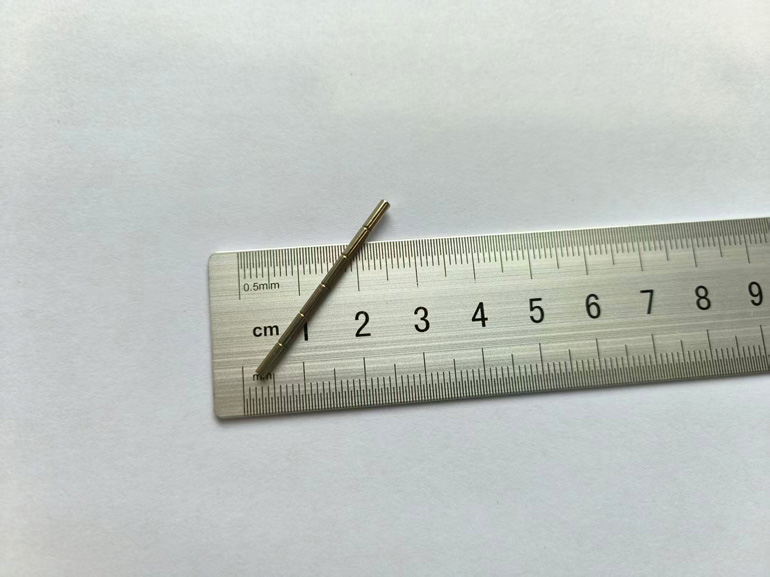
Ultra-small cylindrical magnet
Q5: Can they be magnetised with multiple poles?
Yes, although this depends on the material. It is a relatively challenging process, as the smaller the pole pitch, the higher the requirements for the magnetisation jig.
Q6: What is their temperature resistance like? Are they prone to demagnetisation?Micro magnets are more sensitive to temperature; even if the nominal temperature is not exceeded, partial irreversible demagnetisation may occur.
Q7: How are micro magnets assembled?
Common assembly methods include: adhesive bonding (epoxy, UV adhesive), press-fitting (interference fit) and embedded injection moulding.
Q8: How long is the lead time for prototyping micro-magnets?
Approximately 2–3 weeks; this will be confirmed in consultation with the magnet supplier.
Q9: Which coating should be chosen?
This depends on the magnet material selected. Ferrite and samarium-cobalt magnets do not require a coating; for neodymium-iron-boron magnets, nickel plating is recommended, whilst black epoxy coating may be selected for harsher environments.
Q10: How do I choose the right magnet material?
For high magnetic strength, choose neodymium-iron-boron; for high-temperature resistance and good corrosion resistance, consider samarium-cobalt or ferrite. Samarium-cobalt offers slightly higher magnetic strength.
The above summarises frequently asked questions from customers regarding micro-precision magnets. Should you wish to make a purchase, please feel free to contact our company.
Related small magnet products:
This is a very small rectangular ferrite block magnet, measuring 2.45 mm in length and 1 mm in both width and height. It is magnetised along its length and is barely noticeable when held in the hand....
7.4x6x5mm Ferrite Small Block Magnet Introduction,Material: Hard Ferrite (Ceramic),Shape: Block / Rectangle / Bar,Coating: No Coating,Grade (Chinese Stardard): Y30,Operating temperature: -40°C to 250°C,Delivery time: 7-15 days,Magnetization direction: thickness....
U-shaped neodymium magnets are a type of high-performance permanent magnet material with a structure resembling the letter ‘U’. Manufactured from sintered neodymium-iron-boron, they are characterised by high magnetic energy product....
This is a radial 4-pole ring (Hollow cylinder) magnet, the material is bonded NdFeB, with high magnetic performance, the size is 16mm outer diameter, inner hole 5mm, height 20mm, surface gray epoxy treatment, suitable for water pump motor...
This product is a 4-pole ring magnet, injection-molded ferrite material, the sample size is 22mm outer diameter, 7mm inner diameter, 4mm thickness, 2 N poles and 2 S poles, mainly used for push rod motors, magnetic induction devices, encoders, etc.,...
This is a radial 2 pole circular magnet designed specifically for magnetic encoder chips. It is made of sintered neodymium-iron-boron with N35 grade performance and is suitable for standard environments....
This product is a multi pole magnetic ring with an inner diameter of 1.5mm. The material is injection molded ferrite. It adopts axial multi pole magnetization and is mainly used for DC motors. If you have a sample of similar injection molded magnetic products, please contact us for quotation....
This is a very small size rectangular block magnet with galvanized surface, 3mm length, 1.5mm width and height, with very fine tolerance, magnetized by lengthwise direction, mainly used in precision electronics, instrumentation, please contact us if you need to buy....