
0769-23388351
Toggle Navigation

In the field of magnetic components, “magnetic ring” is a very broad concept. It can refer to ferrite magnetic rings used for inductors and filtering, as well as permanent magnet rings found in motors and sensors. Among these, “encoder magnetic rings” constitute a specialized category of magnetic components with unique functions. Many people tend to confuse the two, but in reality, encoder magnetic rings differ significantly from ordinary magnetic rings. They exhibit fundamental distinctions in structure, magnetization methods, and application scenarios.
In terms of definition, ordinary magnetic rings typically refer to single-pole (commonly one N-pole and one S-pole) ring magnets, primarily used for magnetically attracting, securing, or shielding.
Encoder magnetic rings, however, are precisely multipolar magnetized magnetic rings. They serve as the core component of rotary encoders, working in conjunction with magnetic sensors (such as Hall effect chips or magnetoresistive elements) to output angle, rotational speed, or position signals.
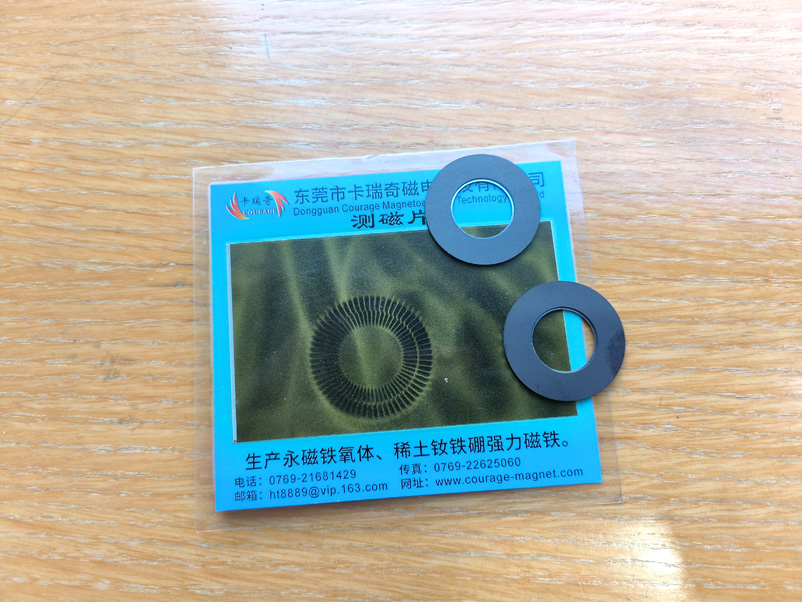
The image below shows are encoder magnetic ring. Our company offers various sizes and different pole configurations.
Now let's examine their differences in magnetic pole configuration. Standard magnetic rings typically feature axial or radial single-pole magnetization with simple pole distribution. Encoder magnetic rings, however, undergo high-precision multi-pole magnetization processing, with pole counts reaching dozens or even hundreds of pairs—such as 32-pole, 64-pole, or 128-pole configurations. Pole distribution must be uniform with consistent spacing; otherwise, it will cause signal distortion and reduced accuracy in encoders.
Regarding materials, common ferrite rings typically use ferrite, neodymium iron boron, or samarium cobalt. Encoder ferrite rings, however, predominantly employ composite materials like injection-molded magnets or bonded magnets.
Their applications also differ significantly. Encoder ferrite rings are primarily used in high-precision motion control fields such as robotic joints, servo motors, and electric vehicle wheel speed sensors. Standard magnetic rings serve conventional applications like packaging, speakers, magnetic products, and suppressing high-frequency noise and electromagnetic interference.
The above outlines key distinctions between encoder magnetic rings and standard magnetic rings. Our company customizes various multi-pole encoder magnetic rings, radial magnetic rings, and axial magnetic rings, supporting injection molding, bonded, and sintered processes to meet diverse precision and application requirements.
Related Products;
Single sided 128 poles and 126 poles magnetic encoder ring magnet
Robot arm encoder magnetic ring 64 pole 49 x 25 x 2 mm
Robot Industry Single-sided Magnet Ring 44.5x25x1.4mm 630 Gauss
Customers from the United States, the United Kingdom, Australia, Japan, Poland and other customers are looking for ferrite cylindrical magnets. Welcome to contact the Courage magnet manufacturer. Our company is located in Dongguan, China. There are many ready-made sizes and low prices. Like the main picture...
The sample is a small-sized Y35 ferrite magnetic block with a specification of 3 × 1.3 × 4mm, magnetized along the length direction, and a surface magnetic field of about 1300 Gauss....
This is a very small rectangular ferrite block magnet, measuring 2.45 mm in length and 1 mm in both width and height. It is magnetised along its length and is barely noticeable when held in the hand....
7.4x6x5mm Ferrite Small Block Magnet Introduction,Material: Hard Ferrite (Ceramic),Shape: Block / Rectangle / Bar,Coating: No Coating,Grade (Chinese Stardard): Y30,Operating temperature: -40°C to 250°C,Delivery time: 7-15 days,Magnetization direction: thickness....
U-shaped neodymium magnets are a type of high-performance permanent magnet material with a structure resembling the letter ‘U’. Manufactured from sintered neodymium-iron-boron, they are characterised by high magnetic energy product....
This is a radial 4-pole ring (Hollow cylinder) magnet, the material is bonded NdFeB, with high magnetic performance, the size is 16mm outer diameter, inner hole 5mm, height 20mm, surface gray epoxy treatment, suitable for water pump motor...
This product is a 4-pole ring magnet, injection-molded ferrite material, the sample size is 22mm outer diameter, 7mm inner diameter, 4mm thickness, 2 N poles and 2 S poles, mainly used for push rod motors, magnetic induction devices, encoders, etc.,...
This is a radial 2 pole circular magnet designed specifically for magnetic encoder chips. It is made of sintered neodymium-iron-boron with N35 grade performance and is suitable for standard environments....