
0769-23388351
Toggle Navigation

The “pole count” on an encoder magnetic ring typically refers to the number of alternating north and south magnetic poles magnetized within a single revolution. For example, a 12-pole ring actually consists of 6 pairs of poles (alternating N/S). The pole count directly determines how many magnetic signal cycles an encoder can generate per revolution, making it one of the core parameters affecting resolution and detection accuracy. So, is 12 poles sufficient?
From an engineering application perspective, a 12-pole magnetic ring represents a low-pole configuration, commonly found in scenarios requiring simple structures, high rotational speeds, and cost sensitivity. Examples include: DC fan speed detection, basic positional determination, and coarse speed feedback for home appliance motors. Such applications prioritize “signal presence and rotational stability” over high-precision angular resolution, making 12 poles entirely sufficient in many cases.
Flexible Ferrite Multi-Pole Magnetic Rings for Magnetic Encoders
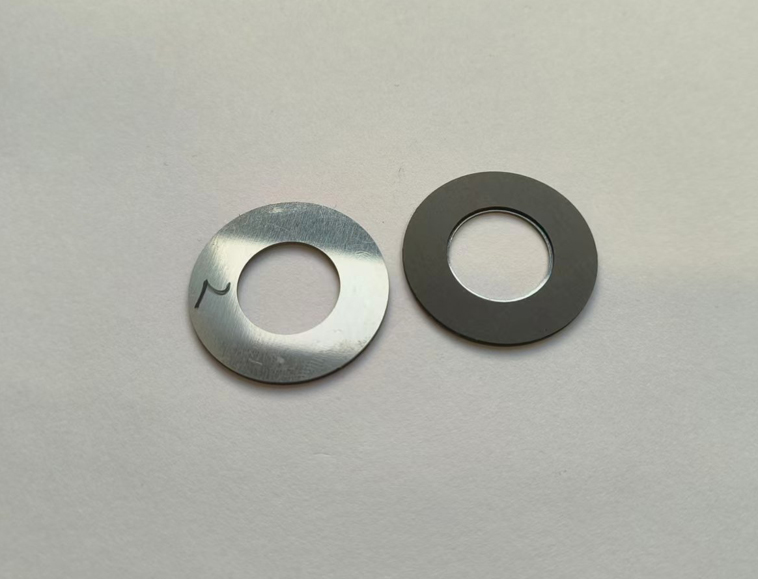
However, when applications demand higher angular resolution, low-speed stability, or closed-loop control precision, 12 poles often prove inadequate. For instance, servo motors, robotic joints, FOC control in power tools, and precision position encoding typically require 32-pole, 48-pole, or even 64-pole (128-pole) multi-pole magnetic encoder rings. A lower pole count leads to low-speed jitter and significant angular quantization errors, compromising control performance.
Whether a magnetic ring is “sufficient” cannot be determined solely by its number of poles. Factors such as the interpolation capability of the Hall/magnetic encoder chip, installation clearance, magnetic ring dimensions, and magnetic material consistency must also be considered. Some high-performance magnetic encoder ICs can achieve smooth speed signals through interpolation even when paired with a 12-pole magnetic ring. Conversely, in poorly designed systems, even a higher number of poles may not yield satisfactory results.
The above covers whether a 12-pole (6-pair) magnetic ring is sufficient for encoders. For speed detection, cost-controlled products, and space-constrained small equipment, 12 poles offer excellent cost-performance. However, for motion control systems demanding high precision and stability, magnetic encoder rings with higher pole counts are recommended.
Related sample display;
Single sided 128 poles and 126 poles magnetic encoder ring magnet
This is a very small rectangular ferrite block magnet, measuring 2.45 mm in length and 1 mm in both width and height. It is magnetised along its length and is barely noticeable when held in the hand....
7.4x6x5mm Ferrite Small Block Magnet Introduction,Material: Hard Ferrite (Ceramic),Shape: Block / Rectangle / Bar,Coating: No Coating,Grade (Chinese Stardard): Y30,Operating temperature: -40°C to 250°C,Delivery time: 7-15 days,Magnetization direction: thickness....
U-shaped neodymium magnets are a type of high-performance permanent magnet material with a structure resembling the letter ‘U’. Manufactured from sintered neodymium-iron-boron, they are characterised by high magnetic energy product....
This is a radial 4-pole ring (Hollow cylinder) magnet, the material is bonded NdFeB, with high magnetic performance, the size is 16mm outer diameter, inner hole 5mm, height 20mm, surface gray epoxy treatment, suitable for water pump motor...
This product is a 4-pole ring magnet, injection-molded ferrite material, the sample size is 22mm outer diameter, 7mm inner diameter, 4mm thickness, 2 N poles and 2 S poles, mainly used for push rod motors, magnetic induction devices, encoders, etc.,...
This is a radial 2 pole circular magnet designed specifically for magnetic encoder chips. It is made of sintered neodymium-iron-boron with N35 grade performance and is suitable for standard environments....
This product is a multi pole magnetic ring with an inner diameter of 1.5mm. The material is injection molded ferrite. It adopts axial multi pole magnetization and is mainly used for DC motors. If you have a sample of similar injection molded magnetic products, please contact us for quotation....
This is a very small size rectangular block magnet with galvanized surface, 3mm length, 1.5mm width and height, with very fine tolerance, magnetized by lengthwise direction, mainly used in precision electronics, instrumentation, please contact us if you need to buy....