
0769-23388351
Toggle Navigation

In the practical application of magnetic materials, nylon magnets and rubber magnets are frequently mentioned. Some people may think they are the same type of magnet, whilst others simply know that they are not easily broken. So what exactly is the difference between the two? Let us now turn to today’s topic.
Firstly, in terms of base materials, nylon magnets are produced by mixing ferrite or neodymium-iron-boron magnetic powder with engineering plastics such as nylon (PA), followed by injection moulding; they are therefore also known as injection-moulded magnets. Rubber magnets, on the other hand, are produced by mixing ferrite magnetic powder with rubber or PVC materials, followed by calendering or extrusion moulding.
There are also significant differences in magnetic performance. Nylon magnets offer better control over moulding density and orientation, resulting in higher residual magnetism and surface Gauss values, with a magnetic energy product reaching 8–12 MGOe. In contrast, rubber magnets are limited by the proportion of magnetic powder they can contain, leading to lower magnetic flux density; their maximum magnetic energy product generally ranges between 0.6 and 1.6 MGOe.
Ferrite-nylon magnets
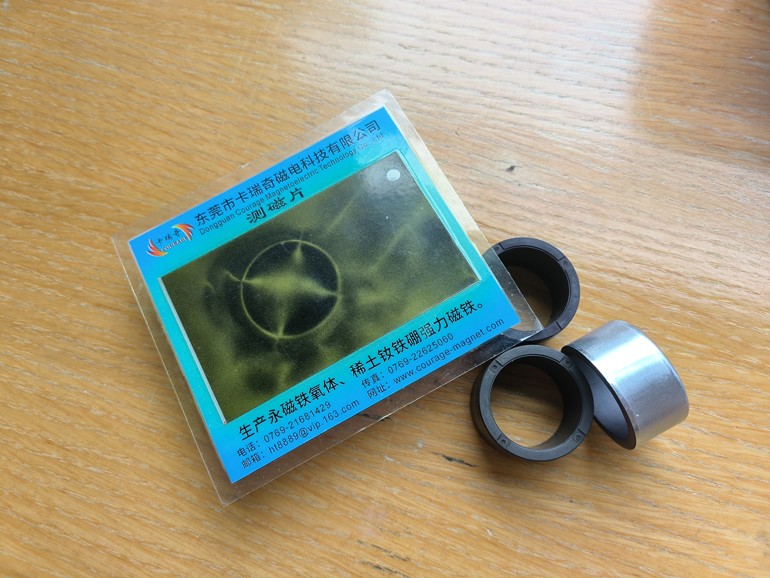
In terms of hardness, nylon magnets, being made from rigid nylon, have a higher surface hardness, are less prone to scratching and offer excellent wear resistance. Rubber magnets, on the other hand, are relatively softer, possessing good flexibility and elasticity, and can be bent or even rolled up.
Their temperature resistance also differs; for instance, nylon magnets generally have a heat resistance of 120–150 °C, whilst rubber magnets typically withstand temperatures between 60 °C and 80 °C.
In terms of cost, nylon magnets involve higher raw material costs and moulding investment, making them suitable for mid- to high-end applications and high-volume production. Rubber magnets, on the other hand, have relatively lower raw material costs and a simple, flexible manufacturing process, making them particularly suitable for small- to medium-volume production and cost-sensitive applications.
Due to these numerous differences, their applications also vary significantly. Nylon magnets are primarily used in motor rotors and stators, encoders and magnetic sensors. Rubber magnets, on the other hand, are commonly found in fridge magnets, door seal strips and advertising magnets, amongst other adhesive or decorative applications.
The above outlines some of the differences between nylon and rubber magnets. Choose nylon magnets if you are seeking magnetic performance, strength and structural integration; opt for rubber magnets if flexibility, low cost and bendability are your priorities.
Direct links to related products:
Nylon PA12 Injection Molding Neodymium Magnets
Flexible Rubber Magnet Block Rectangular 40mm x 35mm x 2.8mm
Fan Motor Flexible Ferrite Rubber Magnetic Tape 202.8x22x3.5mm
This 1mmx1mm miniature circular magnet has a compact size and a surface magnetic field of approximately 2900 Gauss, making it suitable for precision applications with high requirements for magnet size....
This product is a miniature round magnet, made of rare earth NdFeB magnets, belonging to the ultra-small size magnet series, using N35 grade, the specific size is 1.5mm diameter, 1mm thickness, axial magnetization, surface nickel coating, tolerance ±0.05, such as If you are interested in this small magnet product, you can contact us to customize it for you....
Customers from the United States, the United Kingdom, Australia, Japan, Poland and other customers are looking for ferrite cylindrical magnets. Welcome to contact the Courage magnet manufacturer. Our company is located in Dongguan, China. There are many ready-made sizes and low prices. Like the main picture...
The sample is a small-sized Y35 ferrite magnetic block with a specification of 3 × 1.3 × 4mm, magnetized along the length direction, and a surface magnetic field of about 1300 Gauss....
This is a very small rectangular ferrite block magnet, measuring 2.45 mm in length and 1 mm in both width and height. It is magnetised along its length and is barely noticeable when held in the hand....
7.4x6x5mm Ferrite Small Block Magnet Introduction,Material: Hard Ferrite (Ceramic),Shape: Block / Rectangle / Bar,Coating: No Coating,Grade (Chinese Stardard): Y30,Operating temperature: -40°C to 250°C,Delivery time: 7-15 days,Magnetization direction: thickness....
U-shaped neodymium magnets are a type of high-performance permanent magnet material with a structure resembling the letter ‘U’. Manufactured from sintered neodymium-iron-boron, they are characterised by high magnetic energy product....
This is a radial 4-pole ring (Hollow cylinder) magnet, the material is bonded NdFeB, with high magnetic performance, the size is 16mm outer diameter, inner hole 5mm, height 20mm, surface gray epoxy treatment, suitable for water pump motor...