
0769-23388351
Toggle Navigation

What is high-temperature demagnetization? What is the principle of high-temperature demagnetization? What equipment is needed to demagnetize neodymium iron boron strong magnets at high temperatures? How long does it take for demagnetization to occur? With these questions in mind, today's article will clarify them for you one by one.
High temperature demagnetization refers to demagnetizing a magnet that needs to be demagnetized in a high temperature environment. The principle is that in a high temperature environment, if the temperature is higher than the Curie temperature of the magnet (for neodymium iron boron magnets, the Curie temperature is generally above 300 ℃), the thermal motion of the magnet molecules causes the magnetic moments to rearrange haphazardly and in different directions, resulting in an overall non-magnetic appearance. This is the principle of high temperature demagnetization.
What are the methods or equipment for high-temperature demagnetization of neodymium iron boron?
The neodymium iron boron series magnets can be demagnetized using hot oil, with an oil temperature usually reaching 80-200 degrees Celsius, which can completely eliminate magnetism. The disadvantage of this method is that the oil film generated on the surface of the product after hot bath is difficult to treat, and the appearance is not attractive, which many customers may not accept!
In addition, neodymium iron boron magnets can be demagnetized by heating with ovens, high-temperature box furnaces, high-temperature flame guns, etc.
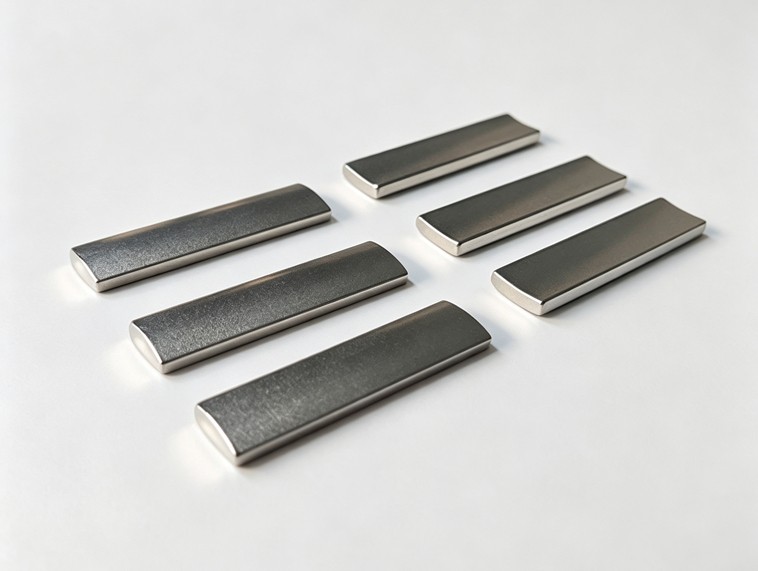
How long does it take for neodymium-iron-boron magnets to demagnetise at high temperatures?
The rate at which neodymium-iron-boron magnets demagnetise at high temperatures depends on a number of factors, including temperature, duration and the specific properties of the material. Generally speaking, demagnetisation at high temperatures is a gradual process rather than a sudden event. The higher the temperature, the faster the demagnetisation rate; furthermore, the longer the exposure, the more pronounced the effect.
Within the temperature range of 300–400 °C, heating for 1–3 hours may result in neodymium-iron-boron magnets being completely demagnetised, losing all magnetic properties.
Within the 200–300 °C temperature range, the magnetic properties of neodymium-iron-boron decline more slowly; it may take 10–20 hours of heating to cause complete demagnetisation.
Within the 150–200 °C temperature range, the decline in magnetic properties is even slower; if exposed to this temperature for an extended period, it may take several tens of hours for complete demagnetisation to occur.
In addition to temperature, the demagnetisation time also depends on the volume and shape of the magnet; the larger the volume and the more compact the shape, the slower the heat transfer rate, and the longer the time required for demagnetisation.
It should be noted that when carrying out high-temperature demagnetisation, the temperature must be carefully controlled to avoid damage to the magnet due to overheating or deformation caused by thermal stress. At the same time, the environmental conditions surrounding the magnet must also be taken into account to ensure that the process is carried out under safe conditions.
Relating to the demagnetisation of magnets;
Will neodymium magnets demagnetize when exposed to instantaneous high temperatures?
Will demagnetization occur below the max working temperature of the magnet?
This is a very small rectangular ferrite block magnet, measuring 2.45 mm in length and 1 mm in both width and height. It is magnetised along its length and is barely noticeable when held in the hand....
7.4x6x5mm Ferrite Small Block Magnet Introduction,Material: Hard Ferrite (Ceramic),Shape: Block / Rectangle / Bar,Coating: No Coating,Grade (Chinese Stardard): Y30,Operating temperature: -40°C to 250°C,Delivery time: 7-15 days,Magnetization direction: thickness....
U-shaped neodymium magnets are a type of high-performance permanent magnet material with a structure resembling the letter ‘U’. Manufactured from sintered neodymium-iron-boron, they are characterised by high magnetic energy product....
This is a radial 4-pole ring (Hollow cylinder) magnet, the material is bonded NdFeB, with high magnetic performance, the size is 16mm outer diameter, inner hole 5mm, height 20mm, surface gray epoxy treatment, suitable for water pump motor...
This product is a 4-pole ring magnet, injection-molded ferrite material, the sample size is 22mm outer diameter, 7mm inner diameter, 4mm thickness, 2 N poles and 2 S poles, mainly used for push rod motors, magnetic induction devices, encoders, etc.,...
This is a radial 2 pole circular magnet designed specifically for magnetic encoder chips. It is made of sintered neodymium-iron-boron with N35 grade performance and is suitable for standard environments....
This product is a multi pole magnetic ring with an inner diameter of 1.5mm. The material is injection molded ferrite. It adopts axial multi pole magnetization and is mainly used for DC motors. If you have a sample of similar injection molded magnetic products, please contact us for quotation....
This is a very small size rectangular block magnet with galvanized surface, 3mm length, 1.5mm width and height, with very fine tolerance, magnetized by lengthwise direction, mainly used in precision electronics, instrumentation, please contact us if you need to buy....