
0769-23388351
Toggle Navigation

When it comes to surface magnetic flux density, I’ve noticed there are so many questions. For example, customers often ask: ‘Which is greater—the surface magnetic flux density at the centre of a magnet or at its edge? Why?’, ‘What is the relationship between a magnet’s surface magnetic flux density and its remanence?’, ‘Is the surface magnetic flux density the same at the N-pole and S-pole of a magnet?’, and so on. Today, I’d like to discuss why one cannot judge a magnet’s magnetic performance based on its surface magnetic flux density.
Firstly, surface magnetic flux density is influenced by the magnet’s dimensions and shape. Even for neodymium-iron-boron magnets of the same grade—for example, N52—if the dimensions, thickness or structure differ, the measured surface magnetic field values will vary considerably. Generally, thicker magnets can generate a stronger surface magnetic field, whilst thinner magnets will have a relatively lower surface magnetic field, even when made from high-performance materials. Therefore, it is impossible to accurately determine the material grade based solely on surface magnetic field values.
Secondly, the method of magnetisation and measurement conditions also affect the surface magnetic field results. Axial, radial and multipole magnetised magnets exhibit completely different magnetic field distributions. In particular, multipole magnetic rings, due to the small spacing between their poles, often yield surface magnetic field values that differ markedly from those of standard bipolar magnets. Furthermore, factors such as the distance between the gaussmeter probe and the magnet’s surface, the measurement location, and the instrument’s accuracy can all lead to variations in the measurement results.
Measurement errors may also exist between gaussmeters of different brands; for instance, the author has encountered discrepancies of around 150–200 gauss between Chinese-made and Japanese gaussmeters.
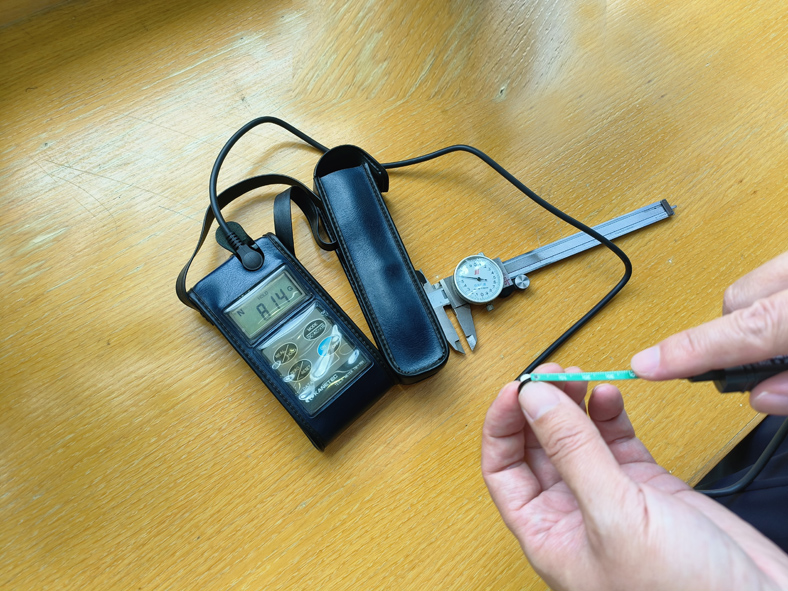
Measuring the surface magnetisation of a magnet using a Gauss meter
The indicators truly used to determine magnetic performance grades are material parameters such as remanence (Br), coercivity (Hcj) and maximum energy product (BHmax); these data must be obtained using specialised magnetic performance testing equipment and standard testing methods. Therefore, surface magnetic flux density can only serve as a reference indicator for the effectiveness of a magnet’s application, and cannot be used as a basis for determining whether it belongs to magnetic performance grades such as N35, N42 or N52.
Related articles:
Injection Molded Ferrite Magnet Surface Gauss Strength
Why does the magnet surface magnetism data measured by gauss meter change?
This is a very small rectangular ferrite block magnet, measuring 2.45 mm in length and 1 mm in both width and height. It is magnetised along its length and is barely noticeable when held in the hand....
7.4x6x5mm Ferrite Small Block Magnet Introduction,Material: Hard Ferrite (Ceramic),Shape: Block / Rectangle / Bar,Coating: No Coating,Grade (Chinese Stardard): Y30,Operating temperature: -40°C to 250°C,Delivery time: 7-15 days,Magnetization direction: thickness....
U-shaped neodymium magnets are a type of high-performance permanent magnet material with a structure resembling the letter ‘U’. Manufactured from sintered neodymium-iron-boron, they are characterised by high magnetic energy product....
This is a radial 4-pole ring (Hollow cylinder) magnet, the material is bonded NdFeB, with high magnetic performance, the size is 16mm outer diameter, inner hole 5mm, height 20mm, surface gray epoxy treatment, suitable for water pump motor...
This product is a 4-pole ring magnet, injection-molded ferrite material, the sample size is 22mm outer diameter, 7mm inner diameter, 4mm thickness, 2 N poles and 2 S poles, mainly used for push rod motors, magnetic induction devices, encoders, etc.,...
This is a radial 2 pole circular magnet designed specifically for magnetic encoder chips. It is made of sintered neodymium-iron-boron with N35 grade performance and is suitable for standard environments....
This product is a multi pole magnetic ring with an inner diameter of 1.5mm. The material is injection molded ferrite. It adopts axial multi pole magnetization and is mainly used for DC motors. If you have a sample of similar injection molded magnetic products, please contact us for quotation....
This is a very small size rectangular block magnet with galvanized surface, 3mm length, 1.5mm width and height, with very fine tolerance, magnetized by lengthwise direction, mainly used in precision electronics, instrumentation, please contact us if you need to buy....