
0769-23388351
Toggle Navigation

Sintered neodymium iron boron (NdFeB) magnets, also commonly referred to as neodymium magnet, is currently the most commercially available permanent magnet material and is known as the "magnetic king". If you want to have a comprehensive understanding of it, just read this article.
Sintered ndfeb magnets are composed of three main elements: neodymium, iron, and boron, with the chemical formula Nd₂Fe₁₄B. They typically also contain dysprosium (Dy), terbium (Tb) to enhance coercivity and temperature stability, cobalt (Co) to increase the Curie temperature, and elements such as niobium (Nb), gallium (Ga), aluminum (Al), and copper (Cu) to improve microstructure and corrosion resistance. Its core manufacturing process is powder metallurgy, which primarily includes melting, powder production, shaping, sintering, heat treatment, mechanical processing, surface treatment, and electroplating.
Regarding the proportion of ingredients, please refer to: Main composition and proportion of rare earth neodymium magnets
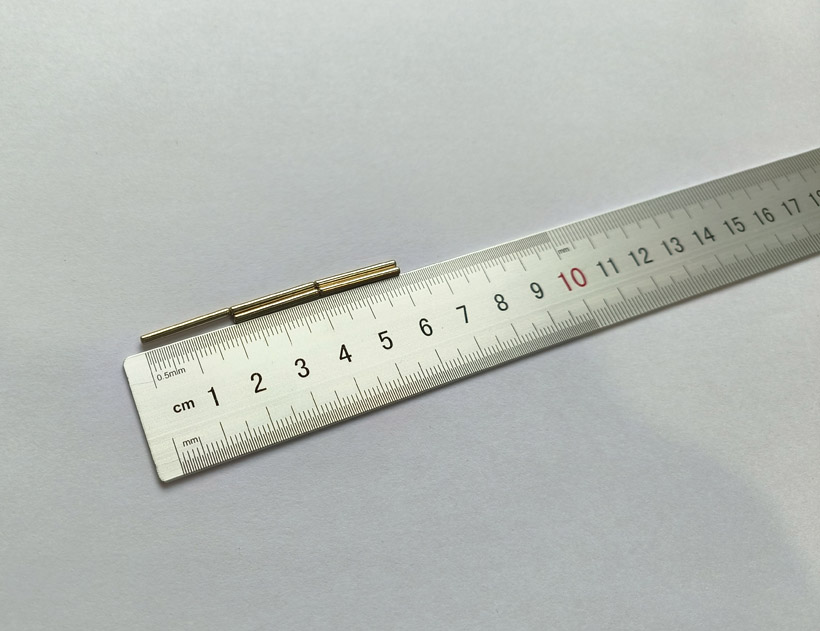
The picture shows 2x20mm neodymium cylindrical magnets.
The theoretical magnetic energy product of sintered ndfeb magnets can reach up to 64 MGOe, with current commercial products exceeding 54 MGOe, and residual magnetism exceeding 1.4 T. This means that under the same magnetic field strength, the volume can be made smaller, or a stronger magnetic field can be provided under the same volume.
Of course, it also has some drawbacks, such as relatively low Curie temperature, poor temperature stability, susceptibility to corrosion, and significant price volatility.
In terms of performance parameters and grades, the key magnetic performance parameters include remanence (the magnetic flux density when the external magnetic field is reduced to zero after the magnet is magnetized to saturation), coercivity, intrinsic coercivity, maximum magnetic energy product (representing the magnet's ability to store magnetic energy, which is the core indicator of comprehensive performance), squareness (the shape of the demagnetization curve, with a more rectangular shape being preferable), and recovery permeability.
For its grade designation, the international standard uses a “number + letter” naming convention (e.g., N52, N42SH, 48H). The number represents the maximum magnetic energy product that the magnet can achieve at room temperature, while the letter indicates the magnet's maximum operating temperature and intrinsic coercivity (Hcj) level.
Sintered ndfeb magnets leverage their high magnetic energy product and high power density to find widespread application in new energy vehicles, industrial motors, home appliances, various magnetic components, salvage equipment, medical instruments, magnetic levitation, acoustic equipment, smart communications, and more.
Currently, sintered ndfeb magnets dominate the permanent magnet market, accounting for the vast majority of the market share (far exceeding bonded neodymium-iron-boron magnets and hot-pressed/hot-deformed neodymium-iron-boron magnets). China is the world's largest producer, consumer, and exporter, accounting for more than 85-90% of global production. Japan and Europe also have a small amount of high-end production capacity.
Sintered NdFeB magnets are significantly stronger than aluminum-nickel-cobalt (AlNiCo) and ferrite magnets, particularly in high-performance motors and precision instruments. However, the main drawback of neodymium iron boron is its high brittleness, making it prone to demagnetization due to impact or high temperatures. As a result, AlNiCo or ferrite materials are more suitable for applications requiring high toughness or high-temperature resistance. AlNiCo has good high-temperature resistance and is suitable for applications in high-temperature environments, while ferrite, due to its low cost and weaker magnetic properties, is commonly used in low-end applications such as speakers and motors.
Similar articles;
This is a very small rectangular ferrite block magnet, measuring 2.45 mm in length and 1 mm in both width and height. It is magnetised along its length and is barely noticeable when held in the hand....
7.4x6x5mm Ferrite Small Block Magnet Introduction,Material: Hard Ferrite (Ceramic),Shape: Block / Rectangle / Bar,Coating: No Coating,Grade (Chinese Stardard): Y30,Operating temperature: -40°C to 250°C,Delivery time: 7-15 days,Magnetization direction: thickness....
U-shaped neodymium magnets are a type of high-performance permanent magnet material with a structure resembling the letter ‘U’. Manufactured from sintered neodymium-iron-boron, they are characterised by high magnetic energy product....
This is a radial 4-pole ring (Hollow cylinder) magnet, the material is bonded NdFeB, with high magnetic performance, the size is 16mm outer diameter, inner hole 5mm, height 20mm, surface gray epoxy treatment, suitable for water pump motor...
This product is a 4-pole ring magnet, injection-molded ferrite material, the sample size is 22mm outer diameter, 7mm inner diameter, 4mm thickness, 2 N poles and 2 S poles, mainly used for push rod motors, magnetic induction devices, encoders, etc.,...
This is a radial 2 pole circular magnet designed specifically for magnetic encoder chips. It is made of sintered neodymium-iron-boron with N35 grade performance and is suitable for standard environments....
This product is a multi pole magnetic ring with an inner diameter of 1.5mm. The material is injection molded ferrite. It adopts axial multi pole magnetization and is mainly used for DC motors. If you have a sample of similar injection molded magnetic products, please contact us for quotation....
This is a very small size rectangular block magnet with galvanized surface, 3mm length, 1.5mm width and height, with very fine tolerance, magnetized by lengthwise direction, mainly used in precision electronics, instrumentation, please contact us if you need to buy....