
0769-23388351
Toggle Navigation

Diametric magnets usually refer to magnets magnetized in the diameter direction, with strong magnetic surfaces on the sides. They are generally circular, ring-shaped, cylindrical, or cylindrical with through holes. Today, let's talk about this type of magnet.
First, in terms of material, various materials can be used, primarily including neodymium iron boron, ferrite, and samarium cobalt. Among these, neodymium is the most commonly used material, especially in applications requiring strong magnetic fields; ferrite has significantly weaker magnetic properties than neodymium iron boron but exhibits better stability in high-temperature and humid environments; samarium cobalt offers superior corrosion resistance and is suitable for use in harsh environments; it is more expensive and has weaker magnetic properties than neodymium iron boron.
Through diameter magnetized cylindrical neodymium magnets
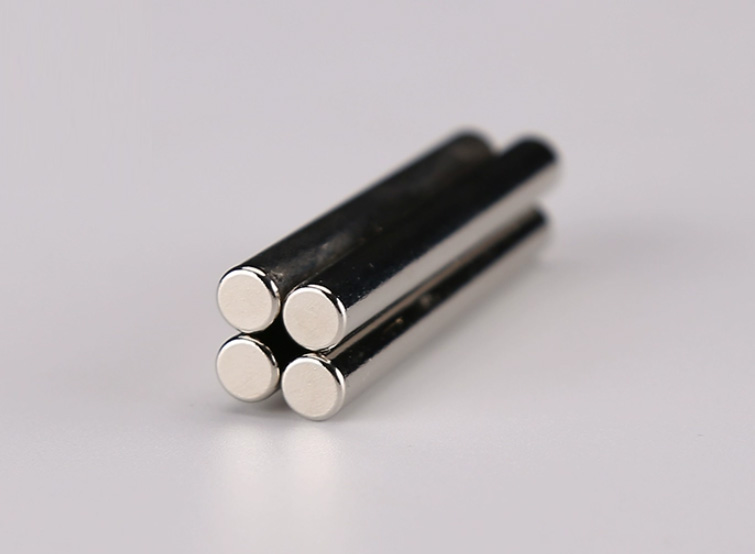
Examples of common sizes for diametric magnets;
Diameter 1 mm, thickness 0.5 mm, 1 mm, 2 mm
Diameter 2 mm, thickness 1 mm, 2 mm, 3 mm
Diameter 3 mm, thickness 2 mm, 3 mm, 5 mm, 6 mm
Diameter 5 mm, thickness 2 mm, 5 mm
Diameter 8 mm, thickness 2 mm, 5 mm
Diameter 10mm, thickness 2mm, 5mm, 10mm
Diameter 20mm, thickness 3mm, 5mm, 10mm, 20mm
Diameter 50-100mm, thickness 10-30mm
Sample:
1mm thick radial rare-earth neodymium magnetic ring 29x18x1mm
Diametrically magnetized magnets
Performance characteristics of diametric magnets:
Magnetic field direction distributed transversely, suitable for motor coil winding induction;
More uniform magnetic field distribution (especially multi-pole magnetization);
Enables precise induction during high-speed rotation, reducing vibration;
Can be used for non-contact angle, position, and speed detection;
Typical applications of diametric magnets;
It is mainly used in the fields of motors, sensors, and encoders. For example, in brushless DC motor rotors, multi-pole radial magnetized magnetic rings are core components. The arc-shaped segmented magnets and arc-shaped magnetic blocks in the rotor are radially magnetized to form a closed magnetic ring. In magnetic encoders, angle and speed information is obtained by detecting multi-pole magnetic pole signals.
The main difference between diameter magnets and axial magnets lies in their different magnetization methods, which results in differences in their magnetic field distribution, applicable scenarios, processing difficulty, and price. For more details, please click: Axially magnetized vs diametrically magnetized
If you need to select diameter magnetized magnets for your actual project, we recommend that you prioritize neodymium iron boron (sintered or bonded) or ferrite (sintered or injection molded) materials, and clearly specify the number of magnetic poles and polarity distribution requirements (such as 12 poles evenly distributed), as well as the surface magnetic field strength requirements.
Other related content;
Hall Sensor General Purpose Magnets - Radial 2 Pole Round
This is a very small rectangular ferrite block magnet, measuring 2.45 mm in length and 1 mm in both width and height. It is magnetised along its length and is barely noticeable when held in the hand....
7.4x6x5mm Ferrite Small Block Magnet Introduction,Material: Hard Ferrite (Ceramic),Shape: Block / Rectangle / Bar,Coating: No Coating,Grade (Chinese Stardard): Y30,Operating temperature: -40°C to 250°C,Delivery time: 7-15 days,Magnetization direction: thickness....
U-shaped neodymium magnets are a type of high-performance permanent magnet material with a structure resembling the letter ‘U’. Manufactured from sintered neodymium-iron-boron, they are characterised by high magnetic energy product....
This is a radial 4-pole ring (Hollow cylinder) magnet, the material is bonded NdFeB, with high magnetic performance, the size is 16mm outer diameter, inner hole 5mm, height 20mm, surface gray epoxy treatment, suitable for water pump motor...
This product is a 4-pole ring magnet, injection-molded ferrite material, the sample size is 22mm outer diameter, 7mm inner diameter, 4mm thickness, 2 N poles and 2 S poles, mainly used for push rod motors, magnetic induction devices, encoders, etc.,...
This is a radial 2 pole circular magnet designed specifically for magnetic encoder chips. It is made of sintered neodymium-iron-boron with N35 grade performance and is suitable for standard environments....
This product is a multi pole magnetic ring with an inner diameter of 1.5mm. The material is injection molded ferrite. It adopts axial multi pole magnetization and is mainly used for DC motors. If you have a sample of similar injection molded magnetic products, please contact us for quotation....
This is a very small size rectangular block magnet with galvanized surface, 3mm length, 1.5mm width and height, with very fine tolerance, magnetized by lengthwise direction, mainly used in precision electronics, instrumentation, please contact us if you need to buy....