
0769-23388351
Toggle Navigation

Many customers encounter the problem of excessive magnetic force when commissioning custom magnets; for example, items become difficult to separate once attached, installation is laborious, and this affects the product’s practical use. So how can this issue be resolved (without resorting to demagnetisation)?
The best solution is to increase the distance between the magnet and the object being held. As the distance increases, the magnetic field weakens rapidly. Adding a layer of plastic, rubber or a thin sheet of stainless steel to the surface of the magnet can increase the gap between the magnet and the surface being held, thereby reducing the actual holding force. Many electronic products and magnetic attachment mechanisms utilise this method to adjust the feel of the product.
Furthermore, the usable magnetic field can be reduced through appropriate design of the magnetic circuit, for example by adding magnetic conductive materials or adjusting the mounting position of the magnet.
Examples of the shapes of some neodymium magnets
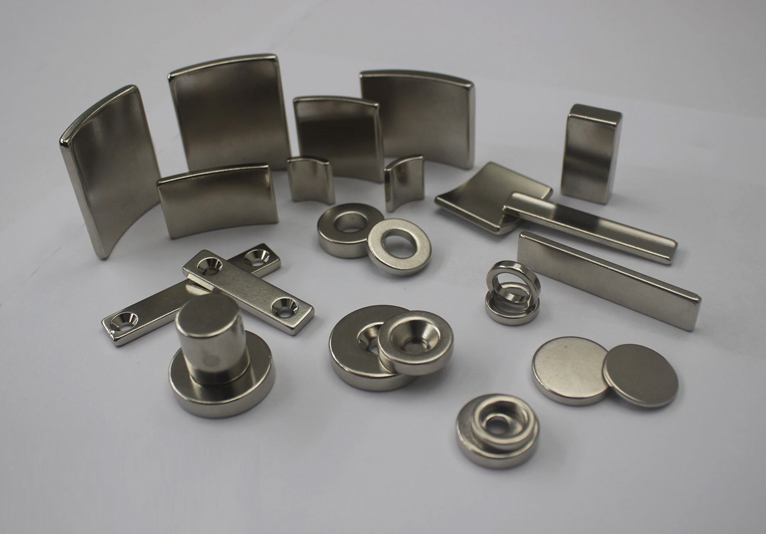
If the project is still at the customised prototype stage, magnetism can be reduced by altering the magnet’s dimensions—such as reducing its thickness—or by changing the magnet material (e.g. replacing neodymium-iron-boron with ferrite) or downgrading its performance (e.g. changing from N42 to N35).
Once the magnets have been manufactured, the options for reducing their magnetic force are relatively limited. It is therefore recommended that magnet selection be carried out during the product development stage, taking into account the installation space, operating distance and required magnetic force, and that the design be continuously optimised through sample testing.
Similar questions;
This 1mmx1mm miniature circular magnet has a compact size and a surface magnetic field of approximately 2900 Gauss, making it suitable for precision applications with high requirements for magnet size....
This product is a miniature round magnet, made of rare earth NdFeB magnets, belonging to the ultra-small size magnet series, using N35 grade, the specific size is 1.5mm diameter, 1mm thickness, axial magnetization, surface nickel coating, tolerance ±0.05, such as If you are interested in this small magnet product, you can contact us to customize it for you....
Customers from the United States, the United Kingdom, Australia, Japan, Poland and other customers are looking for ferrite cylindrical magnets. Welcome to contact the Courage magnet manufacturer. Our company is located in Dongguan, China. There are many ready-made sizes and low prices. Like the main picture...
The sample is a small-sized Y35 ferrite magnetic block with a specification of 3 × 1.3 × 4mm, magnetized along the length direction, and a surface magnetic field of about 1300 Gauss....
This is a very small rectangular ferrite block magnet, measuring 2.45 mm in length and 1 mm in both width and height. It is magnetised along its length and is barely noticeable when held in the hand....
7.4x6x5mm Ferrite Small Block Magnet Introduction,Material: Hard Ferrite (Ceramic),Shape: Block / Rectangle / Bar,Coating: No Coating,Grade (Chinese Stardard): Y30,Operating temperature: -40°C to 250°C,Delivery time: 7-15 days,Magnetization direction: thickness....
U-shaped neodymium magnets are a type of high-performance permanent magnet material with a structure resembling the letter ‘U’. Manufactured from sintered neodymium-iron-boron, they are characterised by high magnetic energy product....
This is a radial 4-pole ring (Hollow cylinder) magnet, the material is bonded NdFeB, with high magnetic performance, the size is 16mm outer diameter, inner hole 5mm, height 20mm, surface gray epoxy treatment, suitable for water pump motor...