
0769-23388351
Toggle Navigation

The origin of coercivity and intrinsic coercivity
Due to different needs, magnets are divided into many grades; when the magnet blank is produced, the manufacturer will obtain the curve graph and four kinds of testing data through the BH testing instrument. Please refer to the BH curve diagram.
The grading of the magnet is determined by four data: remanence BR, maximum magnetic energy product (BH) max, coercive force Hcb, and intrinsic coercive force Hcj.
Details of coercivity
Coercivity, also known as coercivity or coercivity, is one of the characteristics of magnetic materials, and refers to the magnetic field strength required to reduce the magnetization to zero after the magnetic material has been magnetized to magnetic saturation. Coercivity represents the ability of a magnetic material to resist demagnetization and is expressed in the symbol of Hcb, in A/m (International Standard System) or Oe (Gaussian System of Units). Coercivity can be measured with a magnetometer or a B-H analyzer.
Generally speaking, after a magnet passes through a magnetizer and reaches a saturation state after being magnetized, if the force required to degenerate the magnetic force of the magnet to 0 is called coercive force.
For example: the magnetic force of N35 D10*10 is 5000 Gauss, and the force that degenerates 5000 Gauss to 0 Gauss is called coercive force.
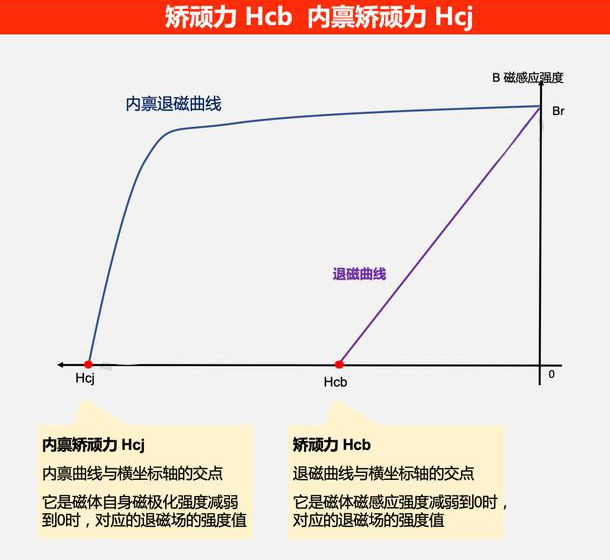
Coercive and intrinsic coercive demagnetization curves
Example
We all know that magnets are magnetized by a magnetizer, and the magnetic field generated by the current passing through the coil is used to magnetize the magnet. Its magnetic circuit is set, usually the upper part of the magnetized thickness is the S pole, and the lower part is the N pole. But if you put the magnetized N pole on top, there will be a weak magnetic phenomenon.
The force of this opposing magnetic field is the coercive force.
The better the coercivity of the magnetic material, the less the phenomenon of weak magnetism will appear.
The worse the coercivity of the magnetic material, the weaker the magnetism will appear. This material may change the magnetic circuit through reverse magnetization, and the N pole will become the S pole.
Intrinsic coercivity explained
The strength of the reverse magnetic field applied when the vector sum of the microscopic magnetic dipole moments inside the magnet is reduced to 0 is called the intrinsic coercive force (Hcj).
You can understand it like this: Intrinsic refers to the interior of the magnet, and intrinsic coercive force is the coercive force inside the magnet.
The difference between intrinsic coercivity and coercivity
When the reverse magnetic field H=Hcb, although the external magnetic induction intensity is zero, the residual magnetization (Br) of the magnet itself is not zero at this time, but the effect of the added reverse magnetic field and Br cancels each other out. When the reverse magnetic field H=Hcj, the residual magnetization of the magnet is reduced to 0.
Intrinsic coercivity characteristics
The intrinsic coercivity is closely related to the temperature stability of rare earth permanent magnets. The higher the intrinsic coercivity, the better the temperature stability.
Its performance is: the intrinsic coercivity of N gear (80℃) is greater than or equal to 12KOe
The intrinsic coercivity of M grade (100℃) is greater than or equal to 14KOe
The intrinsic coercivity of H gear (120℃) is greater than or equal to 17KOe
This article is edited and edited by Courage, a magnet manufacturer in China. Our main products include rare earth neodymium magnets, ceramic ferrite magnets, and multi-pole ring magnets. Friends in need remember to contact us!
This is a very small rectangular ferrite block magnet, measuring 2.45 mm in length and 1 mm in both width and height. It is magnetised along its length and is barely noticeable when held in the hand....
7.4x6x5mm Ferrite Small Block Magnet Introduction,Material: Hard Ferrite (Ceramic),Shape: Block / Rectangle / Bar,Coating: No Coating,Grade (Chinese Stardard): Y30,Operating temperature: -40°C to 250°C,Delivery time: 7-15 days,Magnetization direction: thickness....
U-shaped neodymium magnets are a type of high-performance permanent magnet material with a structure resembling the letter ‘U’. Manufactured from sintered neodymium-iron-boron, they are characterised by high magnetic energy product....
This is a radial 4-pole ring (Hollow cylinder) magnet, the material is bonded NdFeB, with high magnetic performance, the size is 16mm outer diameter, inner hole 5mm, height 20mm, surface gray epoxy treatment, suitable for water pump motor...
This product is a 4-pole ring magnet, injection-molded ferrite material, the sample size is 22mm outer diameter, 7mm inner diameter, 4mm thickness, 2 N poles and 2 S poles, mainly used for push rod motors, magnetic induction devices, encoders, etc.,...
This is a radial 2 pole circular magnet designed specifically for magnetic encoder chips. It is made of sintered neodymium-iron-boron with N35 grade performance and is suitable for standard environments....
This product is a multi pole magnetic ring with an inner diameter of 1.5mm. The material is injection molded ferrite. It adopts axial multi pole magnetization and is mainly used for DC motors. If you have a sample of similar injection molded magnetic products, please contact us for quotation....
This is a very small size rectangular block magnet with galvanized surface, 3mm length, 1.5mm width and height, with very fine tolerance, magnetized by lengthwise direction, mainly used in precision electronics, instrumentation, please contact us if you need to buy....