
0769-23388351
Toggle Navigation

Sintered permanent magnet ferrites and bonded permanent magnet ferrites are two types of ferrite magnetic materials that are currently widely used; the fundamental difference between them lies primarily in their manufacturing processes.
Sintered ferrites are produced using a powder metallurgy process, in which the material is formed via dry or wet pressing and then sintered at high temperatures to achieve densification. The wet pressing process also allows for grain orientation, resulting in superior magnetic properties. In contrast, bonded ferrites are produced by mixing ferrite magnetic powder with a binder, such as resin, and forming the mixture at low temperatures through processes such as extrusion, injection molding, or calendering. As a composite material system, this approach offers process flexibility and is well-suited for the mass production of complex structures.
In terms of magnetic properties, sintered permanent magnet ferrites are significantly superior to bonded ferrites. Due to their dense internal structure and well-aligned magnetic grains, sintered magnets exhibit higher remanence (Br) and magnetic energy product, enabling stronger magnetic flux output. They also have a higher operating temperature (typically up to around 250°C), making them suitable for motors and magnetic circuit systems with high performance requirements. In contrast, bonded ferrites contain a certain proportion of non-magnetic binder, resulting in relatively lower magnetic performance and an operating temperature generally limited to 120°C or below, making them more suitable for applications with medium to low performance requirements.
Sintered Permanent Magnet Ferrite vs. Bonded Permanent Magnet Ferrite
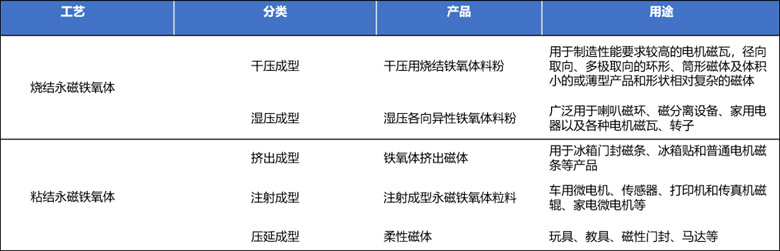
In terms of structure and processing capability, the differences between the two are even more pronounced. Sintered ferrite belongs to brittle materials and can typically only be processed into regular structures such as discs, rings, and tiles, requiring subsequent grinding, which presents issues like edge chipping and brittleness. In contrast, bonded ferrite can be formed in a single step through injection molding or extrusion, enabling the easy production of complex geometric shapes.
In practical applications, sintered permanent magnet ferrites are primarily used in scenarios requiring high magnetic performance, such as fan motors, household appliances, speaker magnetic circuits, and various industrial drive motors, emphasizing high magnetic flux and stability. Bonded permanent magnet ferrites, on the other hand, are widely applied in fields with complex structures or high functional integration requirements, such as automotive micro-motors, magnetic encoders, sensor magnetic rings, printer magnetic rollers, and small drive systems for household appliances, with advantages including high structural freedom and simple assembly.
During the selection process, a balance should be struck based on the product's comprehensive requirements for magnetic properties, structural complexity, operating temperature, and cost. In the field of motors, sintered ferrites remain the mainstream choice, while the application of bonded ferrites continues to grow in encoders, sensors, and intelligent control systems.
Comparison of sintered ferrite magnets with other types of magnets;
This is a very small rectangular ferrite block magnet, measuring 2.45 mm in length and 1 mm in both width and height. It is magnetised along its length and is barely noticeable when held in the hand....
7.4x6x5mm Ferrite Small Block Magnet Introduction,Material: Hard Ferrite (Ceramic),Shape: Block / Rectangle / Bar,Coating: No Coating,Grade (Chinese Stardard): Y30,Operating temperature: -40°C to 250°C,Delivery time: 7-15 days,Magnetization direction: thickness....
U-shaped neodymium magnets are a type of high-performance permanent magnet material with a structure resembling the letter ‘U’. Manufactured from sintered neodymium-iron-boron, they are characterised by high magnetic energy product....
This is a radial 4-pole ring (Hollow cylinder) magnet, the material is bonded NdFeB, with high magnetic performance, the size is 16mm outer diameter, inner hole 5mm, height 20mm, surface gray epoxy treatment, suitable for water pump motor...
This product is a 4-pole ring magnet, injection-molded ferrite material, the sample size is 22mm outer diameter, 7mm inner diameter, 4mm thickness, 2 N poles and 2 S poles, mainly used for push rod motors, magnetic induction devices, encoders, etc.,...
This is a radial 2 pole circular magnet designed specifically for magnetic encoder chips. It is made of sintered neodymium-iron-boron with N35 grade performance and is suitable for standard environments....
This product is a multi pole magnetic ring with an inner diameter of 1.5mm. The material is injection molded ferrite. It adopts axial multi pole magnetization and is mainly used for DC motors. If you have a sample of similar injection molded magnetic products, please contact us for quotation....
This is a very small size rectangular block magnet with galvanized surface, 3mm length, 1.5mm width and height, with very fine tolerance, magnetized by lengthwise direction, mainly used in precision electronics, instrumentation, please contact us if you need to buy....