
0769-23388351
Toggle Navigation

Many people believe that magnets tend to demagnetize at high temperatures, as is indeed the case with rare-earth permanent magnet materials such as neodymium-iron-boron and samarium-cobalt. However, hard ferrites exhibit the exact opposite behavior: they actually demagnetize more easily as the temperature drops. This anomalous phenomenon is considered a “curiosity” in the field of magnetic materials, often leaving engineers encountering it for the first time completely baffled.
For example, a Y30 ferrite magnet with a surface magnetic field of 300 gauss at room temperature (20°C) was measured after being cooled to -40°C. Not only did the magnetic field strength fail to increase, but it actually dropped to approximately 250 gauss—a decrease of 17%. Even more puzzlingly, this decline was largely reversible upon returning to room temperature. This is not permanent material damage, but rather a reversible physical process. During winter testing in northern regions, an automotive parts manufacturer discovered that door lock motors using ferrite magnets exhibited significantly reduced magnetic force at -30°C, causing the door locks to malfunction, whereas the same motors operated normally at 20°C indoors. After bringing the motor back indoors and allowing it to warm up, the magnetic force miraculously returned. This characteristic—where “the lower the temperature, the weaker the magnetism”—completely contradicts engineers’ conventional understanding of magnetic materials.
Integrated sintered ferrite arc-shaped magnet with encapsulation
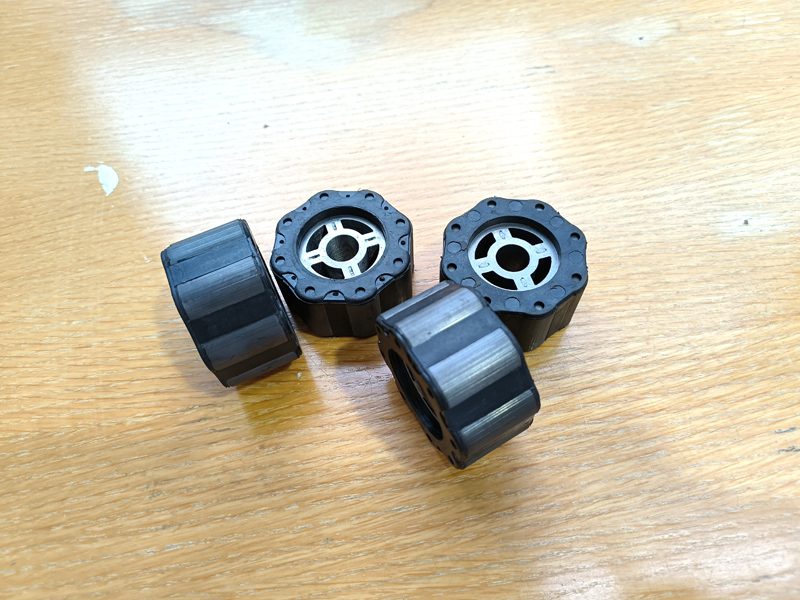
The reason why ferrite magnets are more prone to demagnetization at low temperatures is essentially closely related to the temperature dependent characteristics of their intrinsic magnetic properties - intrinsic coercivity (Hcj). Unlike rare earth permanent magnet materials such as neodymium iron boron, ferrite magnets have a typical "positive temperature coefficient", which means that as the temperature increases, their Hcj actually increases, enhancing the material's ability to resist external reverse magnetic field interference On the contrary, when the temperature decreases, Hcj will significantly decrease, and the anti demagnetization ability of the magnet will weaken accordingly. This characteristic determines that ferrite magnets are in a state of "decreased magnetic stability" in low-temperature environments.
The essential difference between high-temperature demagnetization needs to be clarified. Ferrite does indeed demagnetize at high temperatures (>250 ° C), but that is irreversible permanent damage. High temperatures destroy the magnetic domain structure, and the magnetism cannot be restored after cooling. Low temperature demagnetization is reversible, as the magnetic field weakens during cooling and automatically recovers after heating, without the need for re magnetization. This indicates that low temperature did not disrupt the basic arrangement of magnetic domains, but rather "suppressed" the expression of magnetism to some extent. What's even stranger is that this low-temperature demagnetization phenomenon mainly occurs on permanent ferrite, while soft ferrite (such as manganese zinc ferrite, nickel zinc ferrite) does not have this problem.
Although the low-temperature demagnetization phenomenon of ferrite magnets is "peculiar", as long as we understand its physical essence, respect material laws, and adopt correct strategies, we can completely resolve the risks.
Highly relevant articles;
Curie temperature and demagnetization temperature of ferrite magnets
This is a very small rectangular ferrite block magnet, measuring 2.45 mm in length and 1 mm in both width and height. It is magnetised along its length and is barely noticeable when held in the hand....
7.4x6x5mm Ferrite Small Block Magnet Introduction,Material: Hard Ferrite (Ceramic),Shape: Block / Rectangle / Bar,Coating: No Coating,Grade (Chinese Stardard): Y30,Operating temperature: -40°C to 250°C,Delivery time: 7-15 days,Magnetization direction: thickness....
U-shaped neodymium magnets are a type of high-performance permanent magnet material with a structure resembling the letter ‘U’. Manufactured from sintered neodymium-iron-boron, they are characterised by high magnetic energy product....
This is a radial 4-pole ring (Hollow cylinder) magnet, the material is bonded NdFeB, with high magnetic performance, the size is 16mm outer diameter, inner hole 5mm, height 20mm, surface gray epoxy treatment, suitable for water pump motor...
This product is a 4-pole ring magnet, injection-molded ferrite material, the sample size is 22mm outer diameter, 7mm inner diameter, 4mm thickness, 2 N poles and 2 S poles, mainly used for push rod motors, magnetic induction devices, encoders, etc.,...
This is a radial 2 pole circular magnet designed specifically for magnetic encoder chips. It is made of sintered neodymium-iron-boron with N35 grade performance and is suitable for standard environments....
This product is a multi pole magnetic ring with an inner diameter of 1.5mm. The material is injection molded ferrite. It adopts axial multi pole magnetization and is mainly used for DC motors. If you have a sample of similar injection molded magnetic products, please contact us for quotation....
This is a very small size rectangular block magnet with galvanized surface, 3mm length, 1.5mm width and height, with very fine tolerance, magnetized by lengthwise direction, mainly used in precision electronics, instrumentation, please contact us if you need to buy....