
0769-23388351
Toggle Navigation

Ring magnets are a common type of magnet shape that is widely used in many fields, such as electric motors, electrical appliances, speakers, sensors, and automated equipment. However, different magnetization methods may affect the number of magnetic poles. This article will introduce two common magnetization methods: normal magnetization and multi-pole magnetization.
For most ring magnets, the common magnetization method is ordinary magnetization, i.e., ordinary axial or radial magnetization. This means that ring magnets will have two main magnetic poles, north and south, which follows the general laws of magnetism.
Ordinary magnetization is usually achieved by exposing a ring-shaped magnet to an external magnetic field, causing the magnetic domains (i.e., small magnetic regions) inside the magnet to align along the direction of the external magnetic field. At this point, the annular magnet will exhibit two main polarities, one for the North Pole and the other for the South Pole. Magnetic field lines originate from the North Pole, pass through external space, and ultimately enter the South Pole, forming a closed magnetic field.
Most sintered neodymium magnets are mainly magnetized by ordinary magnetization.
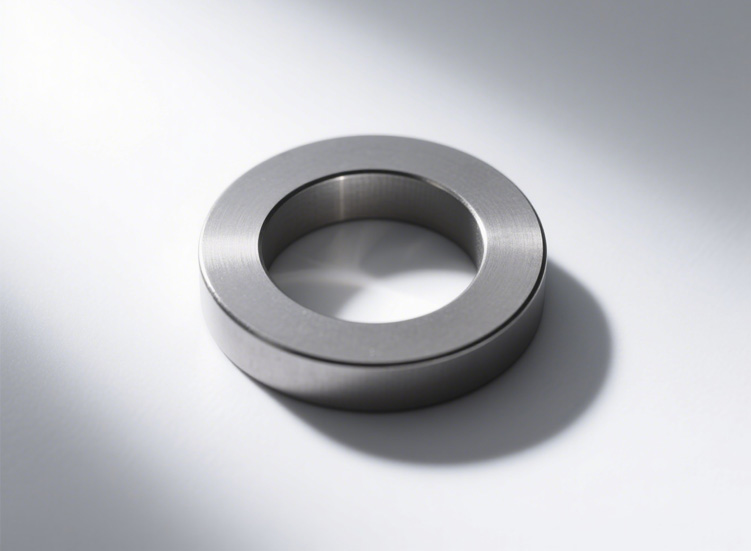
In addition to conventional magnetization methods, ring magnets can also undergo multipole magnetization. This means that there will be multiple magnetic poles on the surface of the magnet, unlike traditional two poles. This magnetization method will form multiple north and south poles on the same circular magnet.
Multi-pole magnetization typically involves using a specific magnetizing fixture to divide the magnetic poles of a ring magnet into multiple regions, each with a north pole and a south pole. As a result, the magnetic field distribution of the ring magnet is no longer a simple two-pole configuration, but rather multiple poles arranged in an alternating pattern. The direction and strength of each pole can be precisely controlled to meet specific application requirements.
Therefore, the number of magnetic poles in a ring magnet is closely related to its magnetization method. Ordinary magnetized ring magnets typically have only two magnetic poles, namely the north pole and south pole, which are suitable for most standard applications. Multi-pole magnetization, on the other hand, creates multiple N S poles on the ring magnet, and is typically used in high-end equipment that requires precise control of magnetic field distribution and changes, such as motors, sensors, and encoders.
Multi-pole ring magnet sample display: https://www.couragemagnet.com/motor-multipole-magnets/
You may be interested in:
Several common magnetization methods of multipole ring magnets
How does multi-pole magnetizing coil magnetize a ring magnet?
This is a very small rectangular ferrite block magnet, measuring 2.45 mm in length and 1 mm in both width and height. It is magnetised along its length and is barely noticeable when held in the hand....
7.4x6x5mm Ferrite Small Block Magnet Introduction,Material: Hard Ferrite (Ceramic),Shape: Block / Rectangle / Bar,Coating: No Coating,Grade (Chinese Stardard): Y30,Operating temperature: -40°C to 250°C,Delivery time: 7-15 days,Magnetization direction: thickness....
U-shaped neodymium magnets are a type of high-performance permanent magnet material with a structure resembling the letter ‘U’. Manufactured from sintered neodymium-iron-boron, they are characterised by high magnetic energy product....
This is a radial 4-pole ring (Hollow cylinder) magnet, the material is bonded NdFeB, with high magnetic performance, the size is 16mm outer diameter, inner hole 5mm, height 20mm, surface gray epoxy treatment, suitable for water pump motor...
This product is a 4-pole ring magnet, injection-molded ferrite material, the sample size is 22mm outer diameter, 7mm inner diameter, 4mm thickness, 2 N poles and 2 S poles, mainly used for push rod motors, magnetic induction devices, encoders, etc.,...
This is a radial 2 pole circular magnet designed specifically for magnetic encoder chips. It is made of sintered neodymium-iron-boron with N35 grade performance and is suitable for standard environments....
This product is a multi pole magnetic ring with an inner diameter of 1.5mm. The material is injection molded ferrite. It adopts axial multi pole magnetization and is mainly used for DC motors. If you have a sample of similar injection molded magnetic products, please contact us for quotation....
This is a very small size rectangular block magnet with galvanized surface, 3mm length, 1.5mm width and height, with very fine tolerance, magnetized by lengthwise direction, mainly used in precision electronics, instrumentation, please contact us if you need to buy....