
0769-23388351
Toggle Navigation

In practical applications of magnets, many people have noticed that a single magnet can support significantly more weight when attached vertically than when attached horizontally. What exactly is going on here? Let’s take a closer look today.
First, let’s look at vertical load-bearing. When a magnet is attached vertically to an iron plate, it primarily experiences a pulling force—that is, the magnet pulls the iron plate directly toward itself. In this case, almost all of the magnet’s magnetic force is used to counteract gravity. As long as the magnetic force is strong enough, the magnet is unlikely to be pulled off, which is why the vertical load-bearing capacity is often very high.
Now let’s look at the parallel load-bearing capacity. When a magnet lies flat on an iron plate and an object attempts to slide along the surface, the magnet itself isn’t being “pulled apart” but rather “pushed along.” In this case, it’s not the magnetic force itself that’s doing the work, but the friction generated by the magnetic force. Since this friction is only a small fraction of the magnetic force, the magnet slides more easily in the parallel direction, and its load-bearing capacity is naturally much lower.
The photo shows pot-type neodymium magnets, which has excellent load-bearing capacity.
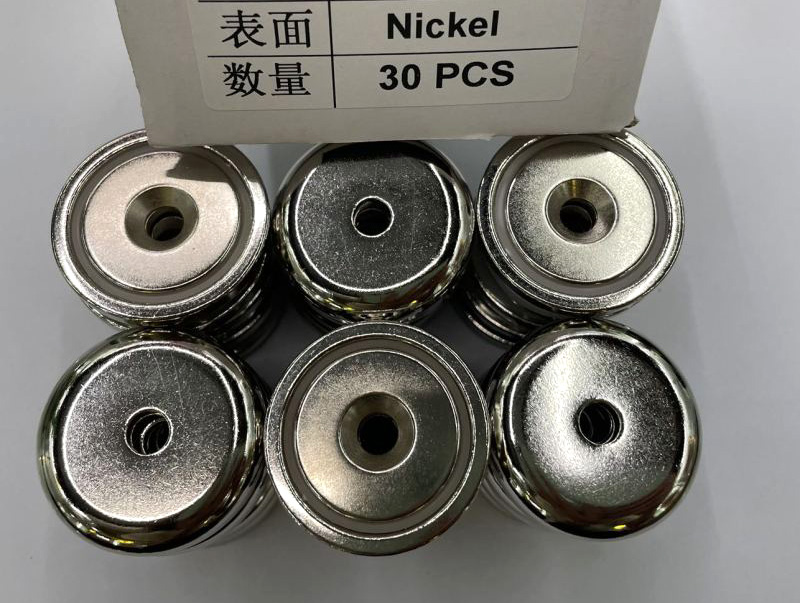
It’s like how it takes a lot of effort to pull two strongly attracted magnets apart directly from above (vertical), but it’s much easier to push them apart from the side (parallel). The difference between the two isn’t due to the quality of the magnets, but is determined by the principles of physics.
Take a circular N35 neodymium magnet with a diameter of 30 mm and a thickness of 5 mm as an example: the vertical pulling force (adhesive force) can reach 8–10 kg, but the parallel sliding force is typically only about 1.5–2.5 kg.
Therefore, in practical applications, if a magnet is required to bear a larger load, it should be subjected to vertical force as much as possible.
Customers from the United States, the United Kingdom, Australia, Japan, Poland and other customers are looking for ferrite cylindrical magnets. Welcome to contact the Courage magnet manufacturer. Our company is located in Dongguan, China. There are many ready-made sizes and low prices. Like the main picture...
The sample is a small-sized Y35 ferrite magnetic block with a specification of 3 × 1.3 × 4mm, magnetized along the length direction, and a surface magnetic field of about 1300 Gauss....
This is a very small rectangular ferrite block magnet, measuring 2.45 mm in length and 1 mm in both width and height. It is magnetised along its length and is barely noticeable when held in the hand....
7.4x6x5mm Ferrite Small Block Magnet Introduction,Material: Hard Ferrite (Ceramic),Shape: Block / Rectangle / Bar,Coating: No Coating,Grade (Chinese Stardard): Y30,Operating temperature: -40°C to 250°C,Delivery time: 7-15 days,Magnetization direction: thickness....
U-shaped neodymium magnets are a type of high-performance permanent magnet material with a structure resembling the letter ‘U’. Manufactured from sintered neodymium-iron-boron, they are characterised by high magnetic energy product....
This is a radial 4-pole ring (Hollow cylinder) magnet, the material is bonded NdFeB, with high magnetic performance, the size is 16mm outer diameter, inner hole 5mm, height 20mm, surface gray epoxy treatment, suitable for water pump motor...
This product is a 4-pole ring magnet, injection-molded ferrite material, the sample size is 22mm outer diameter, 7mm inner diameter, 4mm thickness, 2 N poles and 2 S poles, mainly used for push rod motors, magnetic induction devices, encoders, etc.,...
This is a radial 2 pole circular magnet designed specifically for magnetic encoder chips. It is made of sintered neodymium-iron-boron with N35 grade performance and is suitable for standard environments....